Tuesday, May 31, 2011

Chasing Thunder


Today we painted the Admin building, the backside of it anyway. This week is supposed to focus on painting architecture, and our outside assignment is to paint something architectural. The problem with this is that buildings are hard to paint. They're a mostly flat sort of color and they tend to be very detailed. So the idea is to figure out how to paint buildings without making them too flat or too detailed or too plain.

It was warm and sunny when I started painting today. The sky was a pretty blue and the only clouds were on the horizon line, which was conspicuously hidden behind the building I was attempting to paint. I ran into several issues today, one of them being the quality of my brushes.

They suck.

I'm cheap - I'll say it right now. I don't have a lot of money to buy the quality of art supplies that I need. Mostly this is because I have one shift a week at the coffee shop and I'm in art school. The kind of brush that I need is upwards of 18 dollars a pop. I can't really afford to buy that quality of material, so I splurged and got six brushes for 10 dollars - hence the fact that my brushes really stink. I mean, they do okay and they get me through the day, but they're aren't great.

My teacher lent me his brush to use, which is made from everybody's favorite squirrel hair. Crazy right? A brush made from squirrel. But this brush - it's amazing! It retains loads of water, keeps its shape, and stays saturated for a lot longer than my lesser shape losing brushes. So I decided that I needed a new brush. I'll have to save up for it.

I used the squirrel hair brush on my second painting instead of my mop goat hair brush. It was amazing. And I was just starting to have fun with it when the clouds rolled in. That's the neat thing about Idaho, you know. If you don't like the weather just wait ten minutes - it'll change.

And just when I was finishing up the bottom portion of my painting, I heard it. The loud crash of impending doom, thunder rumbled across the sky. The air took on a different feeling and I was just in love with the moment. I held my breath and hoped it didn't start dumping rain on us while we were still outside. I packed up my stuff and booked it back to my car since class was over.

I took out my camera and snapped some pictures of the crazy clouded sky. It made me wish that cameras could capture atmosphere. They give you the picture so you know what it looked like, but only the person that took the picture or the people that may have been in the picture really remember what it felt like to be there. You can look at a picture and imagine a million different things, but I'm glad that I know what it felt like. That charge in the air, that feeling of an oncoming storm. I live for it.


Just look at that sky, would you? It's so moody and full of feeling. Practically delicious, that sky is. I don't want it to go away. Storms, especially of the thunder and lightening variety, are just my absolute favorite. They are the reason I live for summertime. 

Thursday, May 26, 2011

all your watercolor are belong to me


Normally when one paints with watercolors one mixes the paint with water and applies it to wet or dry paper depending the effect one desires to achieve. Sometimes when one is painting with watercolors other methods of painting can be involved.

Say, like printmaking, I suppose.

Today we combined two of my favorite things, watercolor painting and printmaking. Instead of painting onto paper, the process was more about creating a monoprint. You can paint with the watercolors directly onto a piece of Plexiglas, and while you can't get the range in saturation that you can achieve with a watercolor painting, you can get some pretty neat affects because of the press.

In order to get the watercolors to transfer from the Plexiglas to the paper they need to be pretty saturated, so you don't need to mix them with a lot of water. Think more of a milky/creamy consistency rather than a tea or coffee like consistency.

Then, once you've painted on your Plexi, the paper enters a bath for all of about five or ten seconds depending on the kind of paper you have. After you blot the paper (dry off the excess water) you run the Plexi and the paper through the press.

The result is the above photo. I got a little bored with landscapes, and so I tried painting water. I think the water is my favorite part of that picture, all the different blues and purples and the reflection. It's kind of childlike to me, but then again, I tend to make pretty childlike artwork I think. Not childlike quality, per se, but just childlike ideas and content. It's my style, yo.

So, true to my style I decided to do a mech (robot). I googled a picture on my phone and set to work. I came up with this:


But my paper wasn't wet enough, so it came out a little lighter than I thought it would. I really like it though, I think he's pretty neat looking. So I repainted him and made his weapons fire. I let my paper keep a little extra water in it the second go round as well, so he came out pretty dark, which I love.

Wednesday, May 25, 2011

clouds and cows


Let's be honest. I really don't know how to write about watercolors without gushing about how awesome I think they are every ten seconds. I think the reason I love them so much is because I abhor oil painting. I really should work on that, oil painting isn't so bad...and can be really useful in the life of an artist. Plus, my final painting from last semester? Basically awesome.

I can be a lot more impressionistic with watercolors. It doesn't have to be exactly the way it appears before me in real life. And if I don't want to paint that telephone pole in the middle of the field, I don't have to. If I like those clouds over there, but that tree over here? No big deal! Let's merge 'em! It's like real life photoshop. It's my interpretation of what a place is - not the place how it stands exactly in real life. And that, ladies and gentlemen, makes me feel like an artist instead of like I'm just pretending to be one.


We spend a lot of time outside painting landscapes and clouds. Clouds are some of my favorites, but also very difficult. There's a lot of colors mashed in there instead of just white. And since it's been kinda stormy here lately, the clouds have been pretty intense.

However, today the sky was pretty much a blanket of grey. Not really that interesting to paint. And plus, right now, it's pouring. So I painted from a picture. The rule was that if we painted from a photograph it had to be a photo that we took. And well, you guys know me. I take loads of pictures. And I love landscapes with interesting clouds. So I had a lot to choose from.


I ended up painting a photo that I submitted to the county fair. It's a pretty intense sky, and I like the way this one turned out. I don't ever want to go back to oils again, but I don't think that's possible.

A Shift In Focus


This blog was created in order to help me through a tough art history/theory class last semester. That class is over, and since I am no longer taking any classes from this professor, I don't have a purpose for this blog anymore. I considered deleting it, but then I wondered if there was a different way in which I could utilize this blog.

I am an artist, so I create a lot of art. Usually, I just share my newest stuff on my other blog, but I've often wondered if I should just start an art blog. I'm in school, so I'm constantly creating new art. In order to re-focus my other blog, I decided to start posting all my personal artwork over here on this site instead.

Therefore, many changes will be had over in this little corner of the interwebz, but I think it's for the best. I'm going to try and sell some of my artwork too, so this site could help me do that as well. It will be a big broad adventure I think, and I'm totally excited for it.

Wednesday, April 20, 2011

Postmodernism

There's a big debate about postmodernism. Mostly this debate revolves around nobody really having any clue what postmodernism really is at all. There is a plethora of theories and ideas about postmodernism, but since it wasn't really a true break from the Modern, it doesn't really have a concrete definition.

First, we could look at postmodernism linguistically. Post is a prefix, but it has a few meanings. Against, after, resulting? But how does that relate to modernism? How is it against modernism if it still incorporates ideas from modernism? How is it after modernism, if modernism principles still stand? This is exactly why we can't put a definition on the postmodern.

We discussed two theories in class, Lyotard's theory and Baudrillard's theory. But what it basically boils down to is that no one knows. What happened is that modernism "ended" and thereby postmodernism was born. But the modern didn't really end, it just evolved.

The modernist art, the flat paintings, the post-painterly abstractionists, shapes and colors and non-representation, it all changed into installations and performance. It became about making a statement. The feminists, the Guerrilla Girls, Sherrie Levine and Mapplethorpe. Artists weren't just making art, they were bending the rules. They were changing the way society interpreted them.

Not only were they artists, but they were curators, critics, philosophers. There are no rules anymore. Artists were doing more than art, they were using math and intellect. Creating perspectives and philosophies about their own art. They no longer needed a critic to tell the rest of the world what their art meant because now they could do it themselves. There were no limits, no constraints.

It started in the later 60s and has evolved into the art world that we have today. Take the college that I am attending for example - I don't attend the College of Art. My friends don't go to the College of Architecture. I don't know people who are in the College of Design either. This is because we are all part of the same college, the College of Art and Architecture, which was unheard of before these "hippy" artists decided to take a stand.

So, what is Postmodernism? Postmodernism is now. It's you. It's me. It's us.

Monday, April 11, 2011

The Vietnam War

The Vietnam War was one of the most controversial wars this nation has even known. It started out being about democracy, or so the people thought, but it went downhill from there and by 1967 most Americans were so anti-war it wasn't even funny. What was funny though, is that it seemed that all of the artists had been against the war from the beginning.

The artists saw what was going on in the world, and they wanted to change it. They saw big problems being ignored, and they wanted to do something about it. They used their artwork to communicate their thoughts on the Vietnam war, because the institutes, they felt, were ignoring the problem. This was infuriating to many, many people.

"Art and Language" was a catalog art piece that went on display in a museum. It was an index of ideas - just the way that a business would have a catalog complete with cross references and footnotes - only all the pages in this index were blank - because it was about the ideas. This particular piece of artwork was meant as an absurd joke - it was created in order to show people that art existed in your mind. You didn't need a critic to tell you what an art piece was about, because you could figure it out yourself. It was a direct rejection of the traditional sense of art, proving to the world that the institutes of today were meaningless. There was more going on with the world than people wanted to recognize.

This "Art and Language" piece of conceptual art helped lead the way into even more conceptual pieces. Land art, feminism, etc.

Wednesday, March 9, 2011

Rejection of Indexical Trace

Art and life were once two separate things, but the more and more art developed, the closer those two things became. The avant-garde art is about bringing art and life together - art that pushes the boundaries integrates art and life sometimes without even realizing it.

Rauschenberg's "Bed" is a lovely example of exactly this idea because he literally took his pillow, sheets and quilt and painted directly on those items. Then he hung it vertically in a gallery on display for all to see. He created his art out of thing in his life - thus bringing together art and life into one thing.

Rauschenberg was part of this Neo-Dada art movement, in which his "Bed" artwork was a rejection of what's called "indexical trace." Indexical trace is not unlike what we refer to as "painterly strokes" meaning that within an artwork you can tell where the artist has been. Look at Jackson Pollock's work - any of it really - and you can see where his arm moved with the brush stroke, and then in his later and more famous paintings, you can see the places in which he stood and walked around the canvas dropping a paint trail as he went. De Kooning is also a wonderful example, because his brush strokes are very pronounced in all of his artworks. You can see exactly where he moved his hand and arm while he was creating his masterpieces.

But Rauschenberg was so not all about being able to see where his brush stroked the canvas, he wanted to leave those ideas behind and do something different.

Greenberg was about many things - and some of those things being abstract painting and non-representational paintings done on a flat surface and not made to be something they weren't. A lot of artists really hated Greenberg and what he brought to the table, and in the 60s they started to fully reject what this "great" critic had to say about art and his idea of what good art should be.

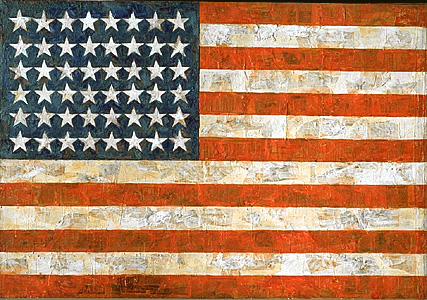
Rauschenberg isn't the only one who rejected Greenberg's ideas by making jokes out of what was said about good art. Jasper Johns rejected Greenberg's "rules" also and openly and defiantly applied Greenberg's rules to his painting "Flag."


Flags are abstract pieces of art printed on fabric most of the time, and they are non-representational. We only know what the thirteen stripes and fifty stars of the American flag represent because that's what someone told us they are there for. But really, there aren't stars on the American flag - it's a rendition of a star, but really just triangle-y lines in an abstract sort of shape.

And Johns also didn't leave behind brush strokes in his work, it's just smooth right there on the canvas.

The point being, that Greenberg's rules about abstraction and non-representation are crap and they can't be applied to everything like Greenberg would have you believe. Essentially, the "Flag" painting is a big joke. A big middle finger from the art world to Mr. Clement Greenberg.

This attitude took on new faces as more and more artists banded together on this idea of rejecting traditional ways of going about creating "art." Because of what we know about art now, we can look back at the history of art and say "Of course this was going to happen! Just look at what those artists were doing!" When in fact, this is a mis-use of history. Lots of different things could have happened, and if we get into the origins of modernism in architecture we can talk about Lebrouste and the use of iron in buildings and all sorts of things that were considered dead ends, but led into another way of doing things that helped to advance the world of art and architecture. But that's really a whole different issue.

But you see my point.

And it wasn't just the rejection of Greenberg that influenced the advancement of art either, it was also artists like Claes Oldenburg and his crazy pieces of public 'pop' art that helped get art back to being joined with life. His work "The Store" done in 1961 helped bring art and life together in a way that hadn't really been done before.


He created things that we use every day, things that we buy in stores and made out of paper and paint. He was effectively creating a store without actually creating a store. By doing this, he was shoving the idea of kitsch and the avant-garde together in one place.

He said something very profound about art and artwork as well. Adorno was really into autonomous art, and making art be separate from society, but in fact Oldenburg took that idea and transformed it by making art that was part of the society, art that fought with society, but instead of buckling under the pressure of society his art would emerge on top and beat out all that other crappy art.


"I am for an art that is political-erotical-mystical, that does something other than sit on its ass in a museum.
I am for an art that grows up not knowing it is art at all, an art given the chance of having a staring point of zero.
I am for an art that embroils itself with the everyday crap & still comes out on top.
I am for an art that imitates the human, that is comic, if necessary, or violent, or whatever is necessary.
I am for an art that takes its form from the lines of life itself, that twists and extends and accumulates and spits and drips, and is heavy and coarse and blunt and sweet and stupid as life itself."

-Claes Oldenburg "I am for an art" 1961

And then folks, I got to thinking about what all of this means. Art takes on a life of its own. It develops and regresses and it changes and different people do different things. You can't control art, you can't take art away, and you can't ignore art.

Art stares you in the face, wherever you go it's always there. It looks at you, emotes you, provokes you, offends you, hates you, judges you, loves you, hands you everything and takes it all away again. But it does effectively one thing - art is philosophical and conceptual and it is, in fact, tied in very closely with life even though it wasn't always that way.